Checklist · Travel agencies and tour operators
The Travel Agency Website Checklist
A practical checklist for travel agency and tour operator websites, in the order travellers meet it: get found, win the comparison, enquire or book, travel, return.
 By Al Amin
Updated · 5 min read
A travel agency website is not a brochure. It is the place where a traveller who found you on Google, in ChatGPT or on Instagram decides whether you are worth an enquiry, or whether they go back to the platform where they started.
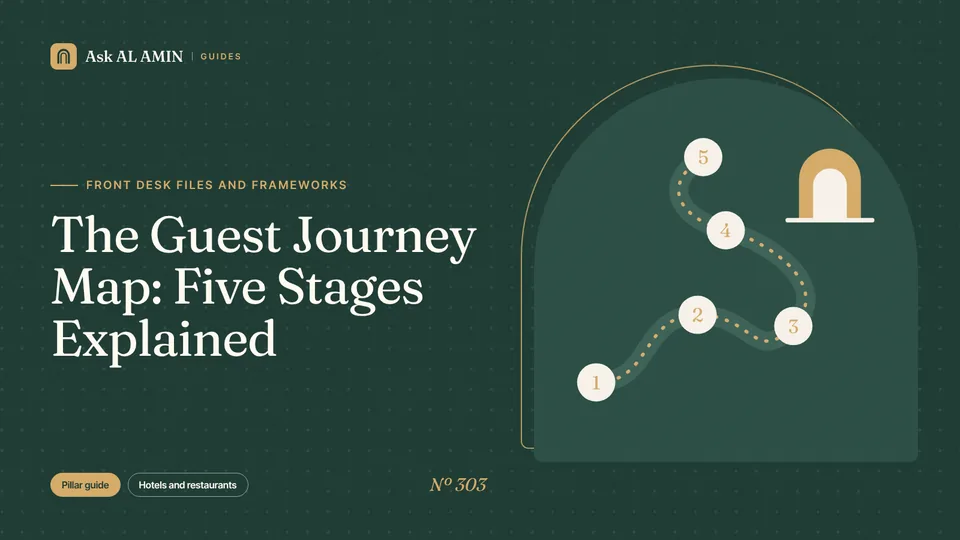
This checklist follows the five stages of the Guest Journey Map, adapted for travel: Search, Decide, Enquire or book, Travel and Return. Fix them in that order of money: anything you can't tick is a leak, and the Leak Model shows how to put a rough price on each one.
Before you start
Test the way your travellers do. Use a mid-range phone, on mobile data, in a private browser window, and pretend you are planning a real trip: a honeymoon in Bali, a family week in Andalusia, an Umrah package for two adults. Note every moment you hesitate. Your office laptop on fast Wi-Fi will hide most of the problems.
Search: can travellers, Google and AI assistants find you?
- Every trip, tour and package has its own page, with its own address. A single "Our trips" page with twenty products hidden in tabs can't rank for any of them, and AI assistants can't quote it.
- Each page title names the trip, the length and who it is for: "Japan in 12 Days for Families, from Barcelona" beats "Japan".
- Every important page has its own description of about 70 to 170 characters that says why to book this trip with you.
- Structured data is in place: TravelAgency or LocalBusiness for the company, TouristTrip for each trip, and FAQPage where you answer questions. It helps Google and AI assistants understand exactly what you sell.
- Your name, address and phone match your Google Business Profile exactly. Small differences between your site, Google and directories weaken trust signals.
- Destination hubs link to the trips. A "Morocco" page that explains the country and links to your three Morocco trips is useful to travellers and to search engines.
- The site speaks your travellers' languages, with real separate pages, not an automatic translation widget.
- Your licence, association membership and insolvency protection are stated in the footer and on an About page. In many countries this is a legal duty, and it is also one of the strongest trust signals you have.
Decide: does the traveller trust you with their trip?
- The first screen shows what you do, for whom and where, in one sentence, with a real photo, not a generic beach.
- Each trip page shows a day-by-day itinerary. Travellers compare itineraries line by line. Vague text loses to a clear plan.
- There is a "from" price, per person, with what it includes. Hidden prices push travellers back to platforms that show them.
- What is included and not included is a clear list: flights, transfers, hotels, meals, guides, entrance fees, visas, insurance.
- Dates and availability are visible, even as a simple "departures every Saturday from April to October".
- Real photos from your own trips appear, ideally with your guides and real travellers, with their permission.
- Recent reviews are shown where the decision happens, on the trip page, not only on a separate testimonials page. Link to the source, such as Google, Tripadvisor or Trustpilot.
- A named person is behind the agency. A photo and a short story of the founder or the team does more for trust than any slogan.
- The page answers the common worries: payment schedule, cancellation, what happens if a flight is cancelled, travel insurance, visas, accessibility.
- Pages load in about three seconds on mobile data. Compress images, avoid autoplay video and heavy sliders.
Enquire or book: is the next step easy?
- Every trip page has one clear call to action above the fold and again at the end: "Check dates and price", "Plan this trip with us" or "Book this tour".
- Day tours and fixed departures can be booked online. For simple, fixed-price products, an enquiry form only slows the traveller down.
- Tailor-made trips have an enquiry form that qualifies: dates or month, number of travellers, approximate budget, departure city and one free text field. Five fields, not fifteen.
- The form says what happens next and when: "You'll get a first proposal within 24 hours, usually much sooner."
- WhatsApp is one tap away, with a pre-filled message that names the trip.
- The phone number is tap-to-call and the opening hours of the sales team are shown, with the time zone.
- Every enquiry gets an instant, useful reply, not an empty "we received your message". Speed to Quote explains how to build one.
- Deposits and payment methods are explained before the traveller commits.
- The booking or enquiry path works in two minutes on a phone. Test it yourself, every month.
Travel: does the website still help after the booking?
- Pre-departure information has its own page or email: documents, luggage, meeting points, emergency contacts.
- Your office address and a map are on the contact page, for travellers who want to visit before they pay.
- An emergency number for travellers on the road is clearly published.
Return: will they book their next trip with you?
- There is an email or WhatsApp sign-up with a reason to join: new departures, early prices, small group trips.
- Every traveller is asked for a review after the trip, never filtered by how happy they were.
- Past travellers are recognised: a returning-traveller offer or a simple "welcome back" from the agent who planned the last trip.
- Social profiles are linked and active, with trips you actually ran.
- Analytics and conversion tracking are in place, so you know which pages, campaigns and channels bring enquiries and booked trips, not just visits.
What to fix first
Start with the Enquire or book checks, because a traveller who reaches them has already chosen you. Then Decide, which is where most travellers quietly leave. Search and the AI assistants come next: how travel agencies get recommended by AI assistants covers that part in depth.
If you'd rather not check all thirty-five by hand, the Guest X-ray tests the online ones in about a minute and puts a price on each failure. You can also see how I work with travel agencies.
FAQ
What should a travel agency website include?
At minimum: one page per trip with a day-by-day itinerary, a "from" price and what is included, real photos and recent reviews, a short enquiry form or online booking, WhatsApp and tap-to-call contact, your licence and protection details, and accurate business details that match Google.
Should a travel agency show prices on its website?
Yes, in most cases. A "from" price per person, with what it includes, filters out travellers who can't afford the trip and reassures those who can. Agencies that hide all prices push travellers back to platforms that show them.
How many fields should a travel enquiry form have?
Around five: dates or month, number of travellers, approximate budget, departure city and a free text field. Each extra field loses some travellers. Ask the rest in your first reply.
Do tour operators need their own website if they sell on Viator or GetYourGuide?
Yes. Marketplaces bring reach but take commission on every booking and keep the customer relationship. Your own site is where you take commission-free bookings, collect traveller details and win the second trip.

Hospitality Growth Strategist. Former hotel front-office executive and digital marketing manager, now studying Tourism at the Universitat Autònoma de Barcelona and growing hotels and restaurants.